Skid Steer Loader Attachments and Their Best Uses
Oct 30, 2026
Choosing skid steer loader attachments starts with the job: what material you need to handle, how much space you have and what your machine can safely power and carry. A bucket suits loose material, forks handle palletised loads, and powered tools add digging or demolition capability—but only when the mounting system, hydraulics and machine capacity match.
For farm owners, landscapers and contractors, the most useful attachment is the one that solves a recurring problem without adding unnecessary weight, maintenance or changeover time. Here is how the main options compare.
Buckets: Standard, Grapple & Snow Buckets
Standard Buckets: Everyday Loading and Grading
A general-purpose bucket is a practical starting point for moving soil, sand, gravel and other loose materials. It also suits backfilling and light grading where the machine and bucket are designed for that work.
Choose the cutting edge for the surface and material. A smooth edge helps with finishing and cleaning firm surfaces; teeth improve penetration into compacted material but leave a rougher finish.
Bucket volume alone does not determine suitability. Wet soil and aggregate can weigh considerably more than light mulch, so a full bucket may exceed the machine’s permitted capacity before it looks overloaded.
Grapple Buckets: Holding Awkward Loads
A grapple bucket adds hydraulic clamps to hold material that would otherwise roll or spill. It is useful for branches, mixed farm debris and irregular loads containing both loose material and larger pieces.
A solid-bottom design retains smaller material. An open-bottom grapple allows some soil and fines to fall through, which can help when sorting brush. However, a heavier grapple leaves less capacity available for the load itself.
Snow Buckets: Moving Volume
Snow buckets typically prioritise volume over digging strength. They suit scooping, stacking and loading snow, particularly where it must be removed from the site.
Match bucket size to snow conditions. Wet or compacted snow places a different demand on the loader from fresh powder. Where snow can be pushed to the edge of an open area, a snow pusher may suit the job better than repeated bucket cycles.
Forks, Grapples & Log Attachments for Forestry/Farm
Pallet Forks: Packaged Materials and Supplies
Pallet forks help move palletised feed, bagged materials and building supplies. Adjustable tine spacing makes them useful across different pallet sizes.
Check both the fork rating and the loader’s permitted capacity with that attachment. A fork frame’s rating does not establish what the machine can safely lift. Load position, attachment weight and lift height all affect the working limit.
Fork length should suit the load while preserving visibility and avoiding unnecessary projection beyond the pallet.
Brush and Root Grapples: Clearing Land
A skid steer grapple is useful for gathering branches, brush and vegetation after cutting or clearing. Open tines can release loose soil while retaining larger debris.
Select tine spacing around what you need to collect. Wide spacing can let smaller branches escape; closer spacing may retain more unwanted soil. Jaw opening and clamp geometry also matter when handling bulky piles.
Do not assume a brush grapple is suitable for digging out stumps or prising embedded rocks. Those tasks require equipment specifically designed and approved for the forces involved.
Log Attachments: Controlling Timber
Dedicated log grapples suit gripping and repositioning timber. Their value comes from controlling a rounded load that may roll out of an ordinary bucket.
Consider log diameter, length, weight and balance. Long timber needs clearance around gates, trees and nearby structures, even when its weight is within the machine’s limit.
For mixed property work, compare skid steer loader configurations for farm and land maintenance against the dimensions and weight of the loads you actually handle.
Augers, Trenchers & Breakers for Construction
Augers: Post Holes and Planting
A skid steer auger suits repetitive holes for fence posts, planting and suitable foundation applications. Match the drive unit and bit to hole diameter, required depth and ground conditions.
A bit intended for ordinary soil may struggle in rock or heavily compacted ground. Increasing diameter also increases torque demand, so a larger bit is not automatically compatible with the same drive.
Check the attachment’s specified hydraulic flow and pressure range. High-flow hydraulics are necessary only where the attachment requires them.
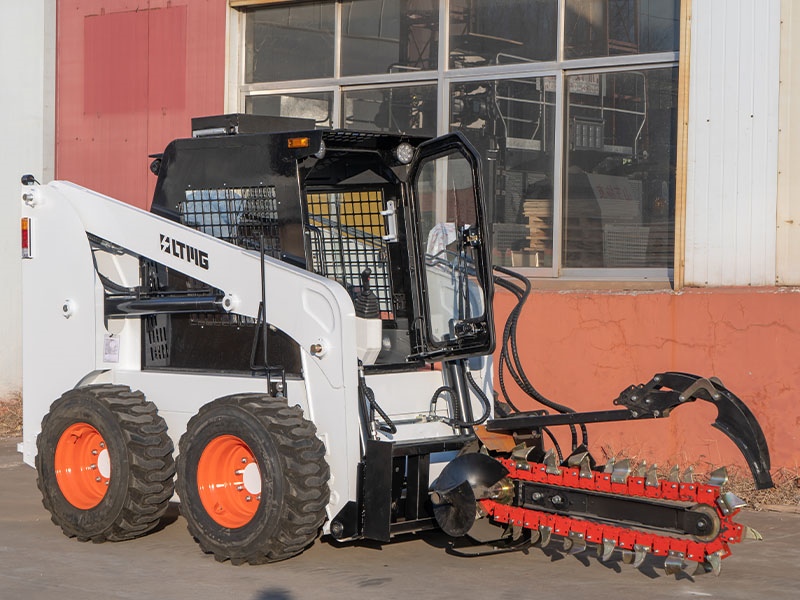
Trenchers: Narrow, Continuous Excavation
Trenchers suit narrow runs for irrigation, drainage and some utility installations. Chain width, digging depth and tooth selection should reflect the trench specification and soil.
They work best where the machine has a clear route and suitable ground conditions. Large rocks, roots and restricted access may make another excavation method more practical.
Confirm underground service locations before disturbing the ground and follow the applicable site procedures.
Breakers: Concrete and Hard Material
Hydraulic breakers suit breaking concrete and other materials within the attachment’s approved application.
Selection depends on the carrier match, hydraulic requirements and material—not simply the largest breaker available. Excessive attachment weight or an unsuitable hydraulic supply can compromise operation.
Ask about return-line requirements, permitted back pressure, cooling needs and any required protective equipment. Follow the machine and attachment manuals for operation, maintenance and exclusion zones.
Quick-Attach Systems: What to Look For
A quick attach loader system simplifies attachment changes, but a matching mounting plate is only one part of compatibility.
Check these points before ordering:
Check
What to confirm
Mechanical fit
Plate dimensions, engagement points, locking arrangement and clearances
Hydraulic supply
Required flow, pressure, return conditions and any case-drain connection
Connections and controls
Coupler type, hose routing and electrical control compatibility
Capacity
Attachment weight, load position and permitted machine capacity
Approved application
Whether the machine and attachment manufacturers permit the combination
How to Choose the Right Attachment for Your Job
The right skid steer loader attachments should match both the task and the host machine. Use the following sequence to narrow your options.
1. Define the work precisely
“Farm work” is too broad. Moving palletised feed, clearing hedge cuttings and drilling fence-post holes require different tools.
2. Identify the limiting condition
Measure load dimensions, access width, working depth and available clearance. Note material density and ground conditions.
3. Check the complete machine–attachment combination
Compare mounting details, attachment weight and hydraulic requirements with the exact loader configuration. Engine power alone does not establish compatibility.
4. Consider frequency and ownership costs
A frequently used bucket or fork set may justify purchase. Hiring a specialist attachment can be more practical for occasional work. Include wear parts, hoses, storage and servicing in the comparison.
5. Request a configuration-specific quotation
When comparing skid steer attachments for sale, provide the loader model, mounting details, auxiliary hydraulic specifications and intended application. Ask the supplier to confirm compatibility in writing.
For example, a property owner regularly moving feed and clearing branches may prioritise forks and a grapple, then hire an auger for a short fencing project. A contractor installing drainage needs to assess trench dimensions and ground conditions before choosing a trencher.
Before ordering, review attachment compatibility and hydraulic configuration requirements with LTMG using your machine details and job specification.
FAQ
How Many Attachments Can One Skid Steer Loader Use?
There is no single maximum number across all machines. One loader can use multiple interchangeable attachments over its working life, usually one at a time. The usable range depends on its mounting system, hydraulics, controls, capacity and manufacturer-approved applications.
Are Attachments Interchangeable Between Different Brands?
Some are, provided the mounting interface and all operating requirements match. Mechanical fit alone is insufficient: hydraulic flow, pressure, electrical controls and load limits must also be compatible. Check the exact machine and attachment combination before purchase.
What Is the Best Attachment for Snow Removal?
Choose a snow pusher for clearing open areas where snow can remain on site, a snow bucket for lifting and loading, or an angled blade for directing snow to one side. A snow blower can suit situations where snow must be thrown beyond the cleared path, provided the loader meets its hydraulic requirements.